Faith Like Rahab

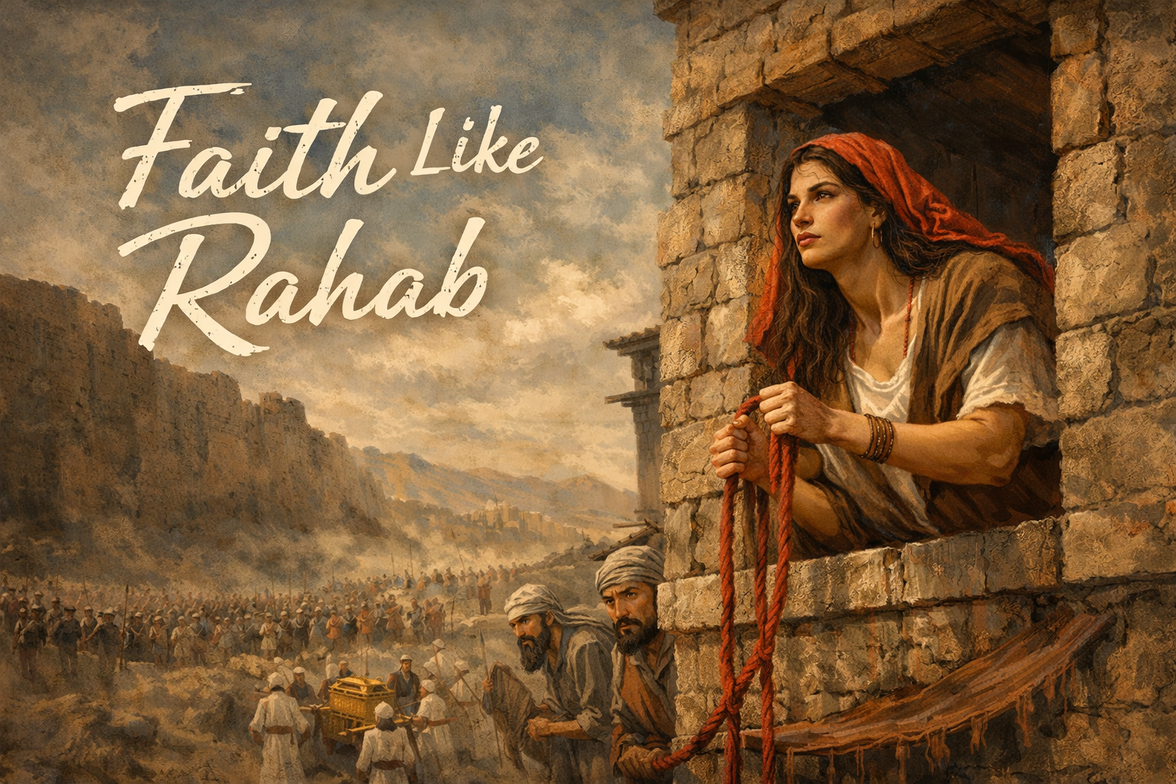
Faith Like Rahab
Text: Hebrews 11:31 • James 2:25 • Joshua 2
Introduction — The Shock of the Story
The Bible does not sanitize Rahab.
It does not say:
-
Rahab the innkeeper
-
Rahab the businesswoman
It says:
Rahab the prostitute.
And the reason the Bible keeps that word is because the gospel is shocking.
Jesus often used shocking statements to confront religious pride.
Jesus stood in front of the religious people who believed they were righteous and said:
“Truly, I say to you, the tax collectors and the prostitutes go into the kingdom of God before you.” — Matthew 21:31
Hebrews 11 says:
“By faith Rahab the prostitute did not perish with those who were disobedient, because she had given a friendly welcome to the spies.” — Hebrews 11:31
Faith of Rahab
James says:
“Was not also Rahab the prostitute justified by works when she received the messengers and sent them out by another way?” — James 2:25
Faith of Rahab
Two massive passages:
-
The Hall of Faith
-
The faith and works passage
Both say the same thing.
Rahab the prostitute.
Faith Like Rahab Knows the Power of God
The story begins in Joshua 2.
“And they went and came into the house of a prostitute whose name was Rahab and lodged there.” — Joshua 2:1
Faith of Rahab
Rahab lived in Jericho.
Jericho was a pagan Canaanite city.
This culture was deeply tied to fertility worship connected to:
-
Baal
-
Asherah
-
Astarte
Historical sources describe prostitution connected to these cult systems.
Ancient historians and archaeological studies describe prostitution connected with temple worship in the ancient Near East.
Sources such as:
Edward Lipiński – studies on Canaanite religion and prostitution.
Herodotus – Histories, Book 1.
These describe sexual rites tied to fertility religion in surrounding cultures.
Rahab lived in that system.
She lived on the city wall, where travelers entered.
She ran an inn and likely managed other women.
She was known by the king.
But Rahab sees something that the rest of Jericho refuses to see.
She hears about the God of Israel.
She hears about:
-
The Red Sea
-
The destruction of kings Sihon and Og
She says:
“For we have heard how the LORD dried up the water of the Red Sea before you when you came out of Egypt…” — Joshua 2:10
Faith of Rahab
And she reaches a conclusion that no one else in the city will admit.
“For the LORD your God, he is God in the heavens above and on the earth beneath.” — Joshua 2:11
Faith of Rahab
Rahab recognizes something.
She is powerless against the power of God.
The whole city hears the same stories.
But only Rahab believes them.
Faith begins when we realize:
God is greater than us.
Faith Like Rahab Makes a Blood Oath
The spies tell her to hang a scarlet cord from her window.
“Then she let them down by a cord through the window…” — Joshua 2:15
Faith of Rahab
The Hebrew word here is:
Chevel — חֶבֶל
Meaning:
rope
sorrow
binding
Psalm 18 says:
“The sorrows of death compassed me…” — Psalm 18:4
Faith of Rahab
But another word appears in the story.
Tiqvah — תִּקְוָה
Meaning:
hope
expectation
cord
Jeremiah says:
“I know the plans I have for you… to give you a future and a hope.” — Jeremiah 29:11
Faith of Rahab
The same word for hope is also used for the scarlet cord.
Rahab’s hope hangs in the window.
That scarlet cord becomes a picture of salvation.
Just like:
-
the blood on the doorposts at Passover
-
the blood of the Lamb
Revelation says:
“And they overcame him by the blood of the Lamb, and by the word of their testimony.” — Revelation 12:11
Faith of Rahab
Rahab is saved by the same pattern.
Blood.
Faith.
Testimony.
Faith Like Rahab - Loves Much Because She Has Been Forgiven Much
Rahab asks for salvation for her entire family.
“Please swear to me by the LORD… you will save alive my father and mother, my brothers and sisters.” — Joshua 2:12–13
Faith of Rahab
Rahab understands something.
The Pharisee thinks:
“If this man were a prophet he would know what kind of woman this is.”
But Jesus says:
“Her sins, which are many, are forgiven; for she loved much.” — Luke 7:47
Faith of Rahab
People who know they have been forgiven much love much.
Rahab understands grace.
And that is why she is in the Hall of Faith.
Conclusion
Rahab becomes something unbelievable.
She becomes part of the lineage of Christ.
A prostitute becomes part of the story of redemption.
The gospel does not begin with perfect people.
It begins with people who believe.
Faith like Rahab:
-
Knows the power of God
-
Makes a blood covenant
-
Loves because it has been forgiven
BLOG POST
Faith Like Rahab
The Bible contains one of the most shocking sentences in the New Testament:
“By faith Rahab the prostitute did not perish…” (Hebrews 11:31)
Notice something.
The Bible refuses to clean up Rahab’s story.
It does not call her a businesswoman or an innkeeper.
It calls her exactly what she was—a prostitute.
Why would Scripture emphasize that?
Because Rahab’s story is a story of grace.
Rahab lived in Jericho, a city devoted to pagan worship and corruption. She worked in the most broken part of that culture. Yet when she heard about the God of Israel—how He parted the Red Sea and defeated mighty kings—she believed.
She declared something that the rest of Jericho refused to admit:
“The LORD your God, He is God in heaven above and on earth beneath.” (Joshua 2:11)
Rahab recognized the power of God.
She hid the Israelite spies and made a covenant with them. They told her to hang a scarlet cord from her window as a sign of protection when Israel attacked the city.
That scarlet cord became her hope.
When Jericho fell, Rahab and her family were saved.
But the story does not end there.
Rahab eventually became part of the lineage of King David—and ultimately the lineage of Jesus Christ.
The message of Rahab’s story is simple but powerful:
God saves people the world would never expect.
Faith is not about having a perfect past.
It is about believing the truth about God.
Rahab believed.
And that faith changed everything.